.jpg)
Your Body Is Connected: How Gut and Liver Health Control Hormones, Thyroid, Skin, and Healing.
- thecrazyvinegarlady
- 3 days ago
- 5 min read
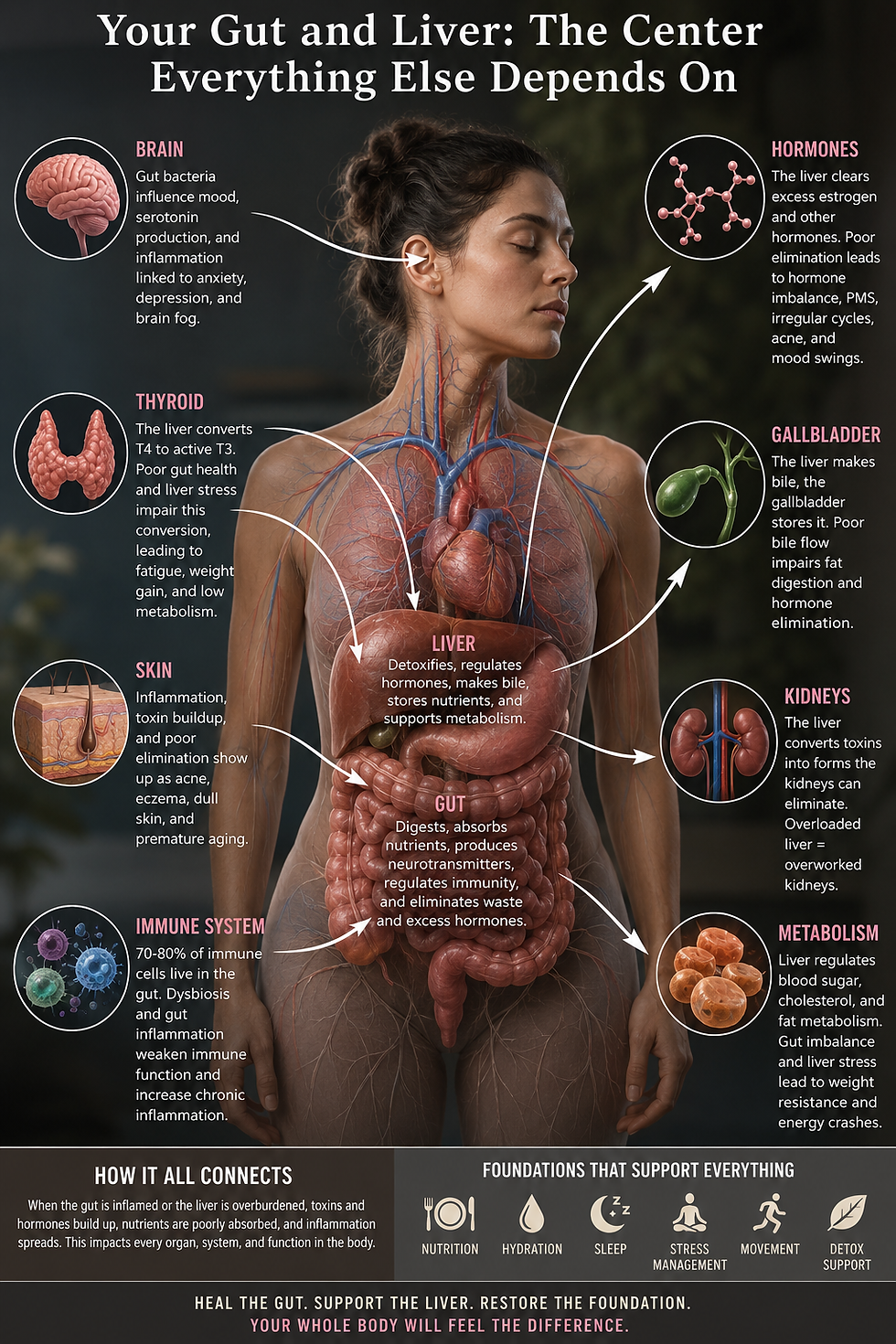
Most people talk about gut health and liver health as if they are separate conversations, but they are not. Your gut and your liver are two of the most influential systems in the body because nearly every other organ depends on what happens there first. Your thyroid depends on them, your hormones depend on them, your skin depends on them, your brain depends on them, your kidneys depend on them, and even your immune system relies on them. When these systems are overloaded, the body rarely fails all at once. It whispers first through fatigue, brain fog, hormonal imbalance, poor sleep, skin inflammation, bloating, gallbladder issues, weight resistance, hair thinning, anxiety, and irregular cycles. People often spend years chasing symptoms while missing the communication breakdown happening underneath. The body was never designed to work in isolated parts. It is a connected network, and the liver and gut are often where that conversation begins.
Most people think the gut’s only job is digestion, but that is only the surface. Your digestive tract is responsible for far more than breaking down food. It plays a major role in immune signaling, nutrient absorption, neurotransmitter production, hormone recycling, inflammation regulation, and even thyroid support. Research from the Cleveland Clinic explains that the digestive tract functions as a major endocrine-related system, producing hormones involved in appetite regulation, metabolism, blood sugar balance, and communication with the brain. This means when the gut becomes inflamed, permeable, or imbalanced, the consequences spread far beyond bloating or stomach discomfort. Someone may have normal lab work and still feel exhausted because dysfunction often begins in communication long before disease appears on paper.
The liver is often simplified into one phrase: detox. While that is true, it barely scratches the surface of what this organ actually does. The liver regulates glucose, cholesterol, hormone metabolism, bile production, inflammation, mineral balance, and fuel metabolism. It also plays a major endocrine role in the body. Research published through the National Library of Medicine shows that the liver helps regulate glucose metabolism, lipid balance, and systemic hormonal signaling. It also produces important compounds like insulin-like growth factor 1 and angiotensinogen, both of which impact growth, blood pressure, and metabolic stability. Your liver is constantly processing estrogen, cortisol, inflammatory compounds, environmental toxins, medications, and excess hormones. When it becomes overburdened, symptoms usually show up somewhere else first. The skin breaks out, the cycle becomes irregular, the thyroid slows down, the gallbladder struggles, sleep becomes lighter, and weight becomes harder to regulate. The liver is often blamed last and burdened first.
One of the biggest missing conversations in hormonal health is how much the thyroid depends on both the gut and the liver. Most people focus only on the thyroid gland itself, but the thyroid does not work alone. The majority of thyroid hormone produced is T4, which must be converted into the active form, T3, for the body to actually use it. Much of that conversion depends heavily on the liver and is strongly influenced by inflammation, nutrient status, and gut health. Research continues to support the close relationship between thyroid hormone activity and liver metabolism, including how thyroid dysfunction can worsen chronic liver stress and how liver dysfunction can impair thyroid conversion. If the gut is inflamed, nutrient absorption drops. If the liver is sluggish, conversion suffers. If inflammation is high, the body may create more reverse T3 instead of active T3. This is why someone can experience exhaustion, thinning hair, feeling cold, and a metabolism that feels completely shut down while focusing only on the thyroid misses the deeper issue underneath.
Hormones themselves are not just about production. They are also about removal. This is where the gut and liver relationship becomes incredibly important. The liver helps package used hormones like estrogen so they can be removed through bile and the digestive tract. If gut function is poor, bowel movements are slow, or dysbiosis is present, those hormones may be reabsorbed instead of eliminated. This creates hormone recycling instead of hormone clearance. Many women experiencing estrogen dominance, PMS, heavier cycles, bloating, breast tenderness, acne, and mood instability are not necessarily producing too much estrogen. Sometimes the body simply cannot clear it effectively. The problem is not always excess. Sometimes it is congestion.
Even the kidneys depend on this system working properly. The liver transforms many fat-soluble compounds into water-soluble compounds so the kidneys can actually eliminate them. Without proper liver support, the kidneys carry a heavier burden. The kidneys also produce hormones like erythropoietin and renin, which help regulate blood pressure and red blood cell production. This is why dehydration, poor mineral balance, adrenal stress, and chronic inflammation often overlap so heavily. Nothing in the body works independently.
The brain feels the gut long before most people realize it. There is a reason stress hits your stomach first. The gut and brain are in constant communication through what is known as the gut-brain axis. Gut bacteria influence serotonin pathways, inflammatory signaling, mood regulation, and even mental clarity. When the gut becomes inflamed, the brain often feels it through anxiety, irritability, depression, and brain fog. Many people believe they have a brain problem when the body is actually sending a message from the gut first. Brain fog is often a body message before it becomes a brain diagnosis.
The gallbladder is another organ people tend to blame without understanding what it is trying to communicate. The liver makes bile, and the gallbladder stores and releases it. If bile becomes sluggish, fat digestion suffers, hormone clearance slows down, and inflammation rises. Low thyroid function can also reduce bile flow, which creates even more gallbladder stress. Many gallbladder issues are not isolated failures but responses to upstream dysfunction. The gallbladder is often the messenger, not the villain.
This is why healing cannot simply be about attacking symptoms. It has to be about restoring communication inside the body. Supporting the system usually begins with simple but powerful foundations: enough minerals, enough protein, stable blood sugar, proper hydration, regular bowel movements, reducing inflammatory product load, supporting bile flow, lowering toxin burden, improving nutrient absorption, and protecting nervous system regulation. Sometimes the most powerful healing is not adding more supplements or more protocols. Sometimes it is removing what keeps overwhelming the system in the first place.
The body is not confused. It is communicating. The gut and liver are often where that message starts. When they struggle, the thyroid speaks. The skin speaks. The hormones speak. The gallbladder speaks. The brain speaks. The goal is not to silence symptoms but to understand the conversation. True healing begins when we stop asking what is wrong with this organ and start asking what this organ is trying to tell us.
And this is why so many people are loving using apple cider vinegar as their soap. So quickly absorbed in their system and helping flush the liver and settle and restore the gut.


Comments